

The importance of deep sleep and REM
It's not just about the amount of hours you sleep; it's about the duration of those hours. You might not be investing enough time in the various phases of sleep if you allow yourself plenty of time to sleep but then have difficulty getting up in the morning or remaining awake all day.
Each stage of sleep in your sleep cycle has its own collection of advantages. Deep sleep (when the body restores itself and stores energy for the next day) and mind- and mood-boosting REM sleep, on the other hand, are especially significant. Avoiding alcohol, smoking, and being awakened throughout the night by noise or illumination will help you get more deep sleep. While having more sleep overall can help you get more REM sleep, you should also consider sleeping an additional 30 minutes or an hour in the morning because the REM stages are longer.
The brain mechanisms that help decide when you fall asleep and wake up control your body's normal everyday rhythms. During sleep, people go through a number of various biochemical processes. Each stage of sleep plays an essential role in maintaining the wellbeing of your brain and body. These cycles of peaceful sleep alternate with intervals of REM (dreaming) sleep during the night. Quiet sleep is beneficial because it makes the body heal, while REM sleep heals the mind and is important for learning and memory.
Your internal clock (circadian rhythms)
The phases of dreaming and waking are triggered by certain brain processes and chemicals. Circadian cycles, for example, are controlled by a pacemaker-like system in the brain. (The term "circadian" means "around a day.") The regular ups and downs of biochemical patterns, such as body temperature, blood pressure, and hormone release, are regulated by this internal clock, which steadily establishes itself over the first months of childhood.
People's need for sleep is highest between midnight and sunrise, and to a smaller degree in the middle of the day, due to circadian rhythms. In one experiment, participants were told to attempt to remain alive for 24 hours. Despite their best intentions, many people found themselves falling asleep. When the researchers plotted the periods when people take unplanned naps, they observed peaks between 2 a.m. and 4 a.m. and 2 p.m. and 3 p.m.
Most people sleep at night, as their circadian patterns determine, but many people who work through the week nap in the afternoon on weekends. People may adapt to their bodies' frequent dips in alertness with a one- to two-hour afternoon nap during the workday and a correspondingly shorter sleep at night in cultures where taking a siesta is the rule.
The effect of light on the body
The correct amount of light at the right time helps hold the circadian clock on target. Exposure at the wrong moment, on the other hand, will cause sleep and wakefulness to change to unfavorable hours. The contribution of light on sleep/wake rhythms is shown by circadian cycle disruptions and sleep disorders that concern up to 90% of blind people.
The passage of time.
There is cognitive strain to keep on time while an individual reads watches, observes job and train plans, and requires that the body be alert for certain activities and social events.
Melatonin
Melatonin is a sleep hormone. Melatonin levels increase after dark and fall after sunrise. The hormone triggers drowsiness, and scientists agree that its daily light-sensitive cycles assist in holding the sleep/wake cycle in balance.
scroll



The two types of sleep
Scientists distinguish between two modes of sleep:
1. Non-REM sleep or peaceful sleep
2. Rapid eye movement (REM) sleep
Surprisingly, they are as dissimilar to one another as they are to awakening.
Quiet or non-REM sleep has been defined as "an idling brain in a movable body" by sleep experts. Thought and other bodily functions slow down at this time, movement is still possible, and people often change positions when they fall deeper into sleep.
Falling asleep
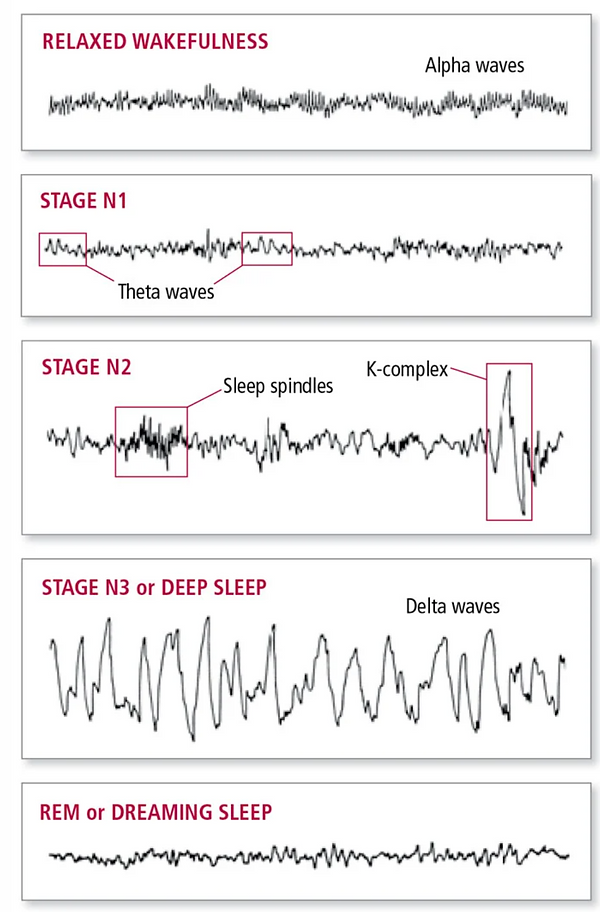
The concept of "fall" into sleep is similar to shifts in brain-wave rhythms at the start of non-REM sleep in several ways. When you're alive, billions of brain cells absorb, evaluate, and organize actions by transmitting electrical impulses to one another. An EEG captures a jumbled, irregular scribble of movement while you're completely awake. Brain waves settle into a slow and rhythmic pattern of around 10 cycles every second until your eyes are closed and your brain no longer provides sensory feedback. The alpha-wave pattern is associated with quiet, peaceful wakefulness
According to science, the shift to peaceful sleep is fast and can be compared to flipping a switch—you are either awake (switch on) or asleep (switch off).
Until anything interrupts the operation, you should be able to sleep through the three stages of peaceful sleep without difficulty.
Quiet (non-REM) sleep has three phases.
N1 is the first level.
You spend approximately five minutes in stage N1 sleep as you transition from wakefulness to light sleep. The prevailing brain waves slow down to four to seven cycles per second on the EEG, a pattern known as theta waves. The body's temperature rises, muscles tense, and the eyes shift steadily from side to side. Step N1 sleepers lose sight of their environment but are quickly startled awake. However, not everyone has the same experience of stage N1 sleep: if awakened, one individual can remember being drowsy, while another may recall being asleep.
N2 is the second level.
The first 10 to 25 minutes of true sleep are spent in this point. Your eyes are closed, and your pulse and heart rhythm are slower than when you are awake. The electrical activity in your brain is erratic. Large, sluggish waves coexist with short bursts of movement known as sleep spindles, which occur when brain waves accelerate for half a second or longer. Spindles, according to scientists, cause the brain to separate from external sensory stimuli and initiate the process of memory consolidation (which involves organizing memories for long-term storage). The EEG traces often reveal a pattern known as a K-complex, which scientists believe is a kind of built-in vigilance mechanism that holds you ready to awaken if required. Certain noises or other external or internal sensations may also cause K-complexes. A K-complex can appear on the EEG if you whisper someone's name during stage N2 sleep. You sleep in stage N2 for around half of the night.
N3 is the third stage (deep sleep, or slow-wave sleep)
Delta waves, which are massive, sluggish brain waves, eventually become a prominent function on the EEG, and you reach deep sleep. The regularity of one's breathing improves. The heart rhythm slows to around 20% to 30% of the waking rate, and blood pressure decreases. Since the brain is less receptive to external stimulation, waking the sleeper is challenging.
Your body regenerates and rebuilds itself through deep sleep.
Your brain gets less blood pressure, which allows it to cool down considerably. The pituitary gland produces a burst of growth hormone at the start of this level, which promotes tissue growth and muscle recovery. Increased blood amounts of compounds that stimulate the immune system have also been found, increasing the likelihood that deep sleep aids the body's protection against infection.
Young people typically invest about 20% of their sleep period in deep sleep periods of up to half an hour, but deep sleep is almost non-existent in most people over 65. When you sleep after a cycle of sleep loss, you move easily into the lighter sleep phases and invest a larger proportion of your sleep time in the deeper stages. This means that deep sleep plays an important role in maintaining alertness and in a person's overall performance.
REM (rapid eye movement) sleep
REM (rapid eye movement) sleep, which has been characterized as a "involved brain in a paralyzed body," is when people dream. When your eyes move back and forth quickly under closed lids, your mind runs, wondering and dreaming. The temperature of your body increases. Your blood pressure rises, and the pulse rate and respiratory rate improve beyond that seen throughout the day. The sympathetic nervous system, which is responsible for the fight-or-flight reflex, is twice as involved while you're sleeping. Despite all of this action, the body hardly moves, with the exception of occasional twitches; muscles not required for breathing or eye movement are silent.
The significance of REM sleep
Scientists believe that, similar to how deep sleep restores your body, REM or dreaming sleep restores your mind, possibly in part by clearing out irrelevant information.
Students who had a decent night's sleep after seeing the puzzle did far better than others who were challenged to solve the puzzle straight away, according to tests on their ability to solve a complicated puzzle containing abstract shapes.
REM sleep has been shown to aid learning and memory in previous research. After a night's sleep, people who were checked to see how effectively they had mastered a new job increased their ratings. The gains were missed if they were awakened on a daily basis, stopping them from getting REM sleep. The changes in the ratings were unchanged if they were awakened from deep sleep an equivalent amount of occasions. Ses results could clarify why students who remain up all night preparing for an exam remember fewer knowledge than their classmates who get some rest.
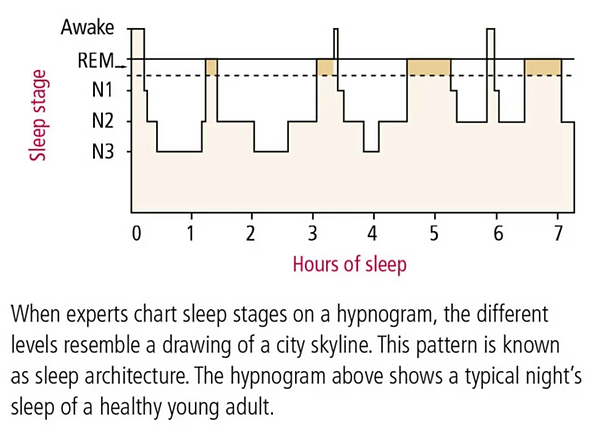
You go into REM sleep 3-5 times a night, or every 90 minutes.
The first REM episode normally lasts just a few minutes, but REM duration gradually grows during the night. The last half-hour of REM sleep may be very long.
If you are denied REM sleep for one night and then given another night of uninterrupted sleep, you can reach this stage early and spend a higher percentage of your sleep period there, a process known as REM rebound.
Architecture of sleep
A typical sleeper transitions through various sleep phases in a reasonably consistent fashion during the night, switching between REM and non-REM sleep. The various levels mimic a drawing of a city skyline while these phases are charted on a map called a hypnogram (see Figure 2). This trend is referred to as sleep design by sleep experts.
In a young adult, natural sleep architecture consists of four to five non-REM and REM cycles that alternate. The first half of the night is where you have the most intense sleep. Longer cycles of REM sleep mix with stage N2 sleep as the night progresses. The sleep skyline changes as you get older, with fewer stage N3 sleep, more stage N1 sleep, and more awakenings.
Many aspects of sleep design are regulated by the brainstem, which also regulates ventilation, blood pressure, and pulse. The pacing of wakefulness, arousal, and the 90-minute switchover between REM and non-REM sleep tends to be coordinated by fluctuating behaviour in nerve cells and the chemical messengers they make.